
Author: admin

  • 40 First Date Ideas That Beat Dinner and a Movie

    40 First Date Ideas That Beat Dinner and a Movie

    The best first dates involve light activity and conversation side by side rather than face-to-face pressure — think mini golf, a farmers market, or a casual walk — and typically last one to two hours so both people can leave wanting more, not less.

    WHY “DINNER AND A MOVIE” ISN’T ALWAYS THE MOVE

    Sitting across from a stranger for two hours with nothing to do but talk can feel like an interview. A movie removes conversation entirely. Neither gives you much real information about compatibility. Below are ideas grouped by type, so you can match the date to the vibe you’re actually going for.

    ACTIVE & LOW-PRESSURE

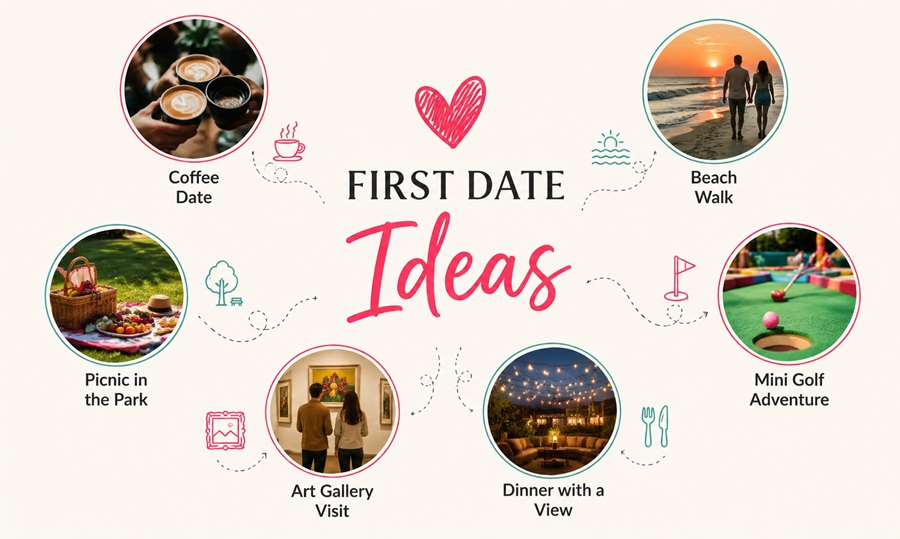
    1. Mini golf
    2. Bowling
    3. Hiking a beginner-friendly trail
    4. Bike rental along a scenic route
    5. Rock climbing (indoor gym, beginner-friendly)
    6. Ice skating or roller skating
    7. Kayak or paddleboard rental
    8. Batting cages

    FOOD & DRINK, WITHOUT THE FORMAL SIT-DOWN

    1. Farmers market with small bites along the way
    2. Food truck park or food hall
    3. Coffee shop crawl (two or three short stops)
    4. Dessert-only date instead of a full meal
    5. Cooking class for two
    6. Wine or beer tasting flight
    7. Picnic in a park

    CREATIVE & LOW-KEY

    1. Paint-and-sip class
    2. Pottery studio walk-in session
    3. Museum or gallery visit
    4. Bookstore browsing followed by coffee
    5. Karaoke (private room, less pressure than open mic)
    6. Trivia night at a local bar
    7. Arcade or retro gaming bar

    DAYTIME OPTIONS

    1. Botanical garden or arboretum walk
    2. Local farmers market
    3. Weekend brunch
    4. Beach or lakeside walk
    5. Aquarium or zoo visit
    6. Scenic overlook hike with a short picnic

    BUDGET-FRIENDLY (UNDER $20 TOTAL)

    1. Free museum days
    2. Public park picnic with snacks from home
    3. Window shopping downtown followed by coffee
    4. Free community events — outdoor concerts, art walks
    5. Library visit followed by a nearby café

    SOMETHING DIFFERENT

    1. Escape room
    2. Local sports game (minor league or college level for lower cost)
    3. Volunteer together for a couple of hours
    4. Comedy show
    5. Night market or seasonal fair
    6. Star-gazing at a nearby park
    7. Farmers market cooking challenge — buy ingredients, cook together after

    WHAT MAKES A FIRST DATE WORK, REGARDLESS OF THE ACTIVITY

    • Choose something with built-in conversation gaps, not constant intense eye contact
    • Keep it to 60–90 minutes with room to extend if it’s going well
    • Pick a public, comfortable setting for safety and ease
    • Avoid anything requiring a big financial or time commitment before you know there’s mutual interest

    A QUICK COMPARISON

    Date Type Best For Watch Out For
    Active dates Easing nerves, natural conversation Physical mismatch in skill/comfort level
    Food-based dates Classic, low-risk Can feel like an interview if too formal
    Creative dates Shared activity, memorable Some require more planning/cost
    Daytime dates Lower pressure, easier exit Less “date” energy for some people

    FAQ

    What’s a good first date idea if we’re both nervous?

    Something active and side-by-side, like mini golf or a walk, tends to ease nerves better than a formal sit-down meal.

    How long should a first date last?

    Most successful first dates run one to two hours — enough time to connect without either person feeling stuck if it’s not clicking.

    Should I plan the whole date or ask what they prefer?

    A mix works best — propose two or three options and let them pick, which shows effort without being overly rigid.

    What if the date is going badly — how do I end it gracefully?

    Be polite and direct: thank them for their time and head out at a natural pause, without over-explaining.

    Are daytime dates better than evening dates for a first meeting?

    Not necessarily better, but often lower-pressure, which some people prefer for an initial meeting.

    What’s a good first date idea for an introvert?

    Museum visits, bookstore browsing, or a quiet coffee shop tend to work well since they don’t require constant high-energy interaction.

  • Emotional Connection: What It Is and How to Build It

    Emotional Connection: What It Is and How to Build It

    There’s a particular kind of loneliness that happens inside a relationship — sitting next to someone you love and still feeling far away from them. That gap usually has a name: a loss of emotional connection. It’s one of the most common things couples bring into therapy, and one of the most fixable, if you know where to look.

    Emotional connection is the sense of being truly known, understood, and safe with another person. It’s built through consistent vulnerability, responsive listening, and shared meaningful experiences — and it can fade with neglect but is generally rebuildable with intentional effort from both people.

    What Emotional Connection Actually Feels Like

    • You can share an unfinished thought and trust it’ll be met with curiosity, not judgment
    • Silence together feels comfortable, not tense
    • You feel like a priority, even during busy or stressful periods
    • Vulnerability is met with responsiveness rather than dismissal

    What Erodes It

    Emotional connection rarely disappears in one dramatic moment. It usually erodes gradually, through:

    • Chronic distraction — phones, work stress, and general “busyness” replacing real conversation
    • Unaddressed resentment that quietly builds over time
    • One-sided emotional labor, where one partner consistently does the listening and rarely receives it back
    • Avoiding vulnerability out of fear of rejection or conflict
    • Physical intimacy continuing while emotional intimacy quietly declines

    Building (or Rebuilding) Emotional Connection

    Step 1: Create Uninterrupted Time

    Even fifteen minutes of phone-free, distraction-free conversation daily makes a measurable difference. Consistency matters more than duration.

    Step 2: Practice Responsive Listening

    When your partner shares something, respond in a way that shows you actually heard it — reflect it back, ask a follow-up, resist the urge to immediately problem-solve unless they’ve asked for advice.

    Step 3: Share Vulnerably, Not Just Informationally

    There’s a difference between “the meeting ran long” and “I felt overlooked in that meeting today.” Emotional connection deepens through the second kind of sharing.

    Step 4: Rebuild Shared Experiences

    Novel, shared activities — even small ones — reactivate the sense of partnership that routine can dull.

    Step 5: Repair After Conflict, Don’t Just Move Past It

    Skipping repair after an argument leaves residue that quietly erodes connection over time, even if the argument itself gets “resolved.”

    A Quick Self-Check

    Ask yourself honestly:

    • When did we last have a conversation that wasn’t logistical (schedules, chores, errands)?
    • Do I feel comfortable being vulnerable with my partner right now?
    • Does my partner know what’s actually stressing me lately?
    • Do we make time for each other, or only find time by accident?

    If most answers are unsettling, that’s useful information — not a verdict on the relationship, but a starting point.

    Emotional Connection vs. Physical Attraction

    Emotional Connection Physical Attraction
    Builds through Vulnerability, trust, shared meaning Chemistry, appearance, novelty
    Fades from Neglect, distraction, unresolved conflict Time, familiarity (though not always)
    Rebuildable Generally yes, with consistent effort Often reignites once emotional closeness returns

    Interestingly, couples often report that physical intimacy improves once emotional connection is restored — the two are more linked than people assume.

    FAQ

    Can emotional connection be rebuilt after years of distance?

    In most cases, yes — it requires consistent effort from both partners, and sometimes professional support, but distance is rarely permanent if both people are willing to reinvest.

    Is it normal for emotional connection to fluctuate?

    Yes. Stress, illness, and major life changes naturally affect closeness; the concern is prolonged disconnection with no attempt to reconnect.

    How is emotional connection different from love?

    Love can persist even when emotional connection has faded temporarily; connection is more about the day-to-day experience of feeling close and understood.

    What role does couples therapy play in rebuilding connection?

    A therapist can help identify communication patterns that block connection and provide structured tools to rebuild it more efficiently than trial and error alone.

    Can you have emotional connection without physical intimacy?

    Yes — emotional connection is possible in relationships with reduced physical intimacy, though most couples report greater overall satisfaction when both are present.

    Emotional connection isn’t a fixed resource you either have or don’t — it’s closer to a muscle. Neglected, it weakens. Used consistently, even in small ways, it strengthens again.

  • Engagement Ring Types: A Complete Buyer’s Guide

    Engagement Ring Types: A Complete Buyer’s Guide

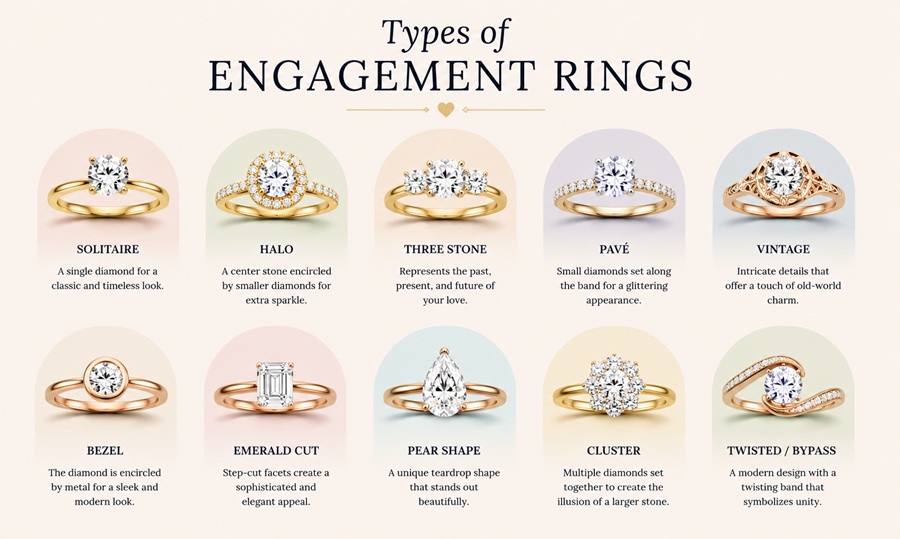
    Buying an engagement ring involves more decisions than most people expect — cut, setting, metal, and stone all interact to determine both the look and the price. This guide walks through the major categories so you can shop with an actual vocabulary instead of just pointing at a display case.

    Quick answer: The main engagement ring types are defined by setting style (solitaire, halo, three-stone, vintage, pavé) and diamond or gemstone cut (round, princess, oval, cushion, emerald, pear). Solitaire and halo settings remain the most popular choices, while cut affects both appearance and price per carat.

    Ring Settings

    Solitaire – A single stone, usually held by four or six prongs. Timeless, versatile, and generally the most budget-friendly setting for a given carat weight.

    Halo –  A center stone surrounded by a ring of smaller diamonds. Makes the center stone look larger and adds extra sparkle.

    Three-Stone –  Symbolizes past, present, and future. A center stone flanked by two smaller stones, often the same shape.

    Vintage / Antique-Inspired –  Intricate metalwork, milgrain detailing, filigree patterns. Popular for couples wanting a design with more character.

    Pavé –  Small diamonds set closely along the band, adding shimmer without a large budget increase.

    Bezel –  The stone is fully or partially wrapped in metal. Extremely durable and a good choice for active lifestyles.

    Diamond and Gemstone Cuts

    Cut Shape Notable For
    Round Brilliant Circular Maximum sparkle, most popular cut overall
    Princess Square Modern look, strong brilliance
    Oval Elongated round Appears larger per carat, elongates the finger
    Cushion Rounded square Vintage feel, soft brilliance
    Emerald Rectangular, step-cut Elegant, shows clarity more than sparkle
    Pear Teardrop Unique silhouette, slimming visual effect
    Marquise Elongated with pointed ends Maximizes perceived size

    Metal Options

    • Platinum — durable, naturally white, hypoallergenic, higher cost
    • White gold — similar look to platinum at a lower price, needs occasional replating
    • Yellow gold — classic, low-maintenance, complements vintage styles
    • Rose gold — warm tone, increasingly popular for modern and vintage designs

    Budget Considerations

    Setting style and cut both affect price independent of carat weight. A halo setting can make a smaller center stone appear larger, which is a common strategy for balancing budget with visual impact. Step cuts like emerald show inclusions more visibly than brilliant cuts, so clarity matters more when choosing that shape.

    How to Choose

    1. Consider their existing jewelry style — do they wear delicate pieces or bold statement jewelry?
    2. Balance the “Four Cs” (cut, color, clarity, carat) against your budget — cut generally has the biggest visual impact
    3. Think about lifestyle — active hands may do better with a bezel or low-profile setting
    4. If unsure, a classic solitaire or halo is the safest choice and rarely goes out of style

    FAQ

    What’s the most popular engagement ring style right now?

    Solitaire and halo settings remain the two most commonly chosen styles, according to major jewelry retailers’ sales data.

    Is a bigger carat weight always better?

    Not necessarily — cut quality often has a greater impact on visual sparkle than carat size alone.

    What’s the difference between platinum and white gold?

    Platinum is naturally white and more durable but pricier; white gold achieves a similar look through rhodium plating, which needs periodic reapplication.

    Are lab-grown diamonds a good option?

    Yes for many buyers — they’re chemically identical to mined diamonds but typically cost significantly less for the same size and quality.

    How do I choose the right ring size without them knowing?

    Borrow a ring they already wear on the correct finger and have a jeweler measure it, or ask a close friend or family member for help.

    What ring setting is most durable for active lifestyles?

    Bezel settings offer the most protection since the metal fully surrounds the stone, reducing the risk of snagging or chipping.

  • 60+ Conversation Starters That Don’t Feel Forced

    60+ Conversation Starters That Don’t Feel Forced

     good conversation starters are specific, open-ended, and low-pressure — questions like “what’s something you’ve changed your mind about recently?” work better than generic ones like “how are you?” because they invite a real answer instead of a scripted one.

    Silence at the start of a conversation feels a lot bigger than it actually is. The fix usually isn’t a clever line — it’s a good question, asked with genuine curiosity. Below are starters organized by situation, so you’re not stuck reaching for “so… nice weather.”

    WHY MOST CONVERSATION STARTERS FALL FLAT

    Most generic openers fail for one of two reasons: they’re too closed (yes/no answers kill momentum) or too impersonal (nobody has a real answer to “what’s your favorite color”). The starters below avoid both traps.

    FOR A FIRST DATE

    • What’s something you’ve gotten really into recently?
    • What does a perfect ordinary Sunday look like for you?
    • What’s a small thing that instantly puts you in a good mood?
    • If you could instantly become an expert in something, what would it be?
    • What’s a trip that changed how you see things?
    • What’s something you believed as a kid that you laugh about now?

    FOR MEETING SOMEONE NEW SOCIALLY

    • How do you know the host / how did you two meet?
    • What’s taking up most of your time these days?
    • What’s the best thing you’ve read, watched, or listened to lately?
    • Is there a project you’re excited about right now?

    FOR DEEPER CONVERSATIONS

    • What’s something you’ve changed your mind about in the last few years?
    • What does support look like to you when things are hard?
    • What’s a risk you took that you’re glad you did?
    • What do you wish more people asked you about?
    • What’s something you’re proud of that most people wouldn’t guess?

    FOR COWORKERS AND PROFESSIONAL SETTINGS

    • What’s a project you’re excited to work on this quarter?
    • How did you end up in this field?
    • What’s something you learned this week that surprised you?
    • What’s the best career advice you’ve ever gotten?

    FOR LONG CAR RIDES OR QUIET MOMENTS

    • Would you rather questions (time travel, superpowers, dream jobs)
    • What’s a memory that always makes you laugh?
    • What’s a skill you wish you had time to learn?
    • What’s a place you haven’t been but really want to visit?

    A QUICK COMPARISON: WEAK VS. STRONG STARTERS

    Weak: “How’s it going?” → Strong: “What’s been the highlight of your week so far?” Weak: “Do you like your job?” → Strong: “What’s the most interesting part of what you do?” Weak: “Nice weather, huh?” → Strong: “Do you have a favorite season, and why?”

    TIPS FOR KEEPING THE CONVERSATION GOING

    1. Follow up on details they mention instead of moving to your next prepared question
    2. Share something about yourself in return — conversation is a trade, not an interview
    3. Watch their energy; if a topic isn’t landing, pivot without dwelling on it
    4. Use silence comfortably — not every gap needs to be filled instantly

    FAQ

    Q: What’s a conversation starter that works for almost anyone?

    A: “What’s been the best part of your week?” works across nearly every context because it’s specific but still easy to answer.

    Q: How do I keep a conversation going after the opener?

    A: Ask a genuine follow-up question about what they just said rather than switching to an unrelated topic.

    Q: Are conversation starters different for texting versus talking in person?

    A: Slightly — text-based openers tend to work better when they’re a little more concrete, since tone and body language aren’t available to soften an abstract question.

    Q: What should I avoid asking as a conversation starter?

    A: Anything that can be answered in one word, and anything too personal for the level of familiarity you actually have with the person.

    Q: Is it okay to prepare conversation starters in advance?

    A: Yes — having a few in your back pocket for nerve-wracking situations like first dates or networking events is completely normal and often makes conversation flow more naturally.

    The best conversation starters aren’t clever — they’re just genuinely curious. Ask like you actually want to know the answer, and most people will meet you there.

  • How to Deal With a Breakup: A Step-by-Step Guide

    How to Deal With a Breakup: A Step-by-Step Guide

    No one gets through a breakup without it hurting somewhere. The question isn’t whether it’s going to be hard — it’s whether you’re going to move through it in a way that leaves you steadier, or stuck. Here’s a practical, stage-by-stage way to think about it.

    Dealing with a breakup well means allowing yourself to grieve, limiting contact with your ex to create space to heal, leaning on your support system, and rebuilding routines and identity outside the relationship — typically over a period of weeks to a few months, depending on the relationship’s length and intensity.

    Week One: Let Yourself Feel It

    The instinct to immediately “get over it” backfires more often than it helps. In the first days:

    • Cry if you need to — suppressing grief usually just delays it
    • Cancel obligations you genuinely can’t face; don’t cancel everything
    • Avoid major decisions (quitting a job, moving cities) made purely from acute pain
    • Tell a small number of trusted people what happened so you’re not carrying it alone

    The No-Contact Period

    Most therapists recommend a period of reduced or no contact with an ex, especially in the first month. This isn’t about punishment — it’s about giving your nervous system room to recalibrate without repeated reactivation.

    What no-contact typically includes:

    • Muting or unfollowing on social media, at least temporarily
    • Avoiding “just checking in” texts
    • Removing easy access points — shared photos on your home screen, saved playlists on repeat
    • Asking mutual friends not to relay information back and forth

    Common Breakup Stages

    Stage What It Often Looks Like Typical Timing
    Shock/denial Numbness, disbelief First days
    Grief/sadness Crying, low motivation, rumination Weeks 1–4
    Anger/bargaining Frustration, “what if” thinking Weeks 2–6
    Acceptance Reduced intensity, more good days than bad 1–3 months+
    Rebuilding New routines, renewed interest in life Ongoing

    These stages aren’t strictly linear — most people bounce between them rather than moving cleanly from one to the next.

    Practical Steps to Take

    1. Rebuild your routine. Predictable structure (sleep, meals, exercise) stabilizes mood even when emotions are volatile.
    2. Reconnect with people outside the relationship. Isolation tends to intensify breakup pain.
    3. Redirect the energy. A project, hobby, or goal gives your attention somewhere to land besides the loss.
    4. Process, don’t just distract. Journaling or talking it through with a friend or therapist helps you actually integrate the experience rather than just outrun it.
    5. Watch for signs you need extra support. Persistent inability to function, intrusive thoughts, or depression symptoms lasting weeks warrant professional help.

    What Not to Do

    • Don’t rebound into a new relationship purely to avoid the discomfort of being alone
    • Don’t rehearse the relationship’s ending on repeat with mutual friends
    • Don’t use alcohol or other substances as your primary coping tool
    • Don’t monitor your ex’s social media as a substitute for actually moving forward

    When It’s Okay to Reconnect (If Ever)

    Some relationships genuinely do reconcile, but that’s usually only healthy after both people have had real space, done individual reflection, and can identify what would actually be different. Reconnecting purely out of loneliness rarely resolves the original issues.

    FAQ

    How long does it normally take to get over a breakup?

    It varies widely, but many people notice meaningful improvement within six to twelve weeks, with full emotional resolution sometimes taking several months for longer relationships.

    Is no contact necessary after every breakup?

    Not always mandatory, but strongly recommended for at least a few weeks in most cases, especially when the breakup was recent or painful.

    Should I stay friends with my ex right away?

    Generally no — attempting friendship too soon often reopens the wound before it’s had a chance to heal.

    Is it normal to still think about them months later?

    Yes, occasional thoughts are normal; what matters is whether the intensity and frequency are decreasing over time.

    When should I see a therapist after a breakup?

    If sadness significantly interferes with work, sleep, or daily functioning for more than a couple of weeks, professional support is worth considering.

    Can journaling actually help with breakup recovery?

    Yes — putting feelings into words has been shown to help people process and regulate difficult emotions more effectively than rumination alone.

    Is it healthy to date again quickly after a breakup?

    It depends on the person, but rushing into dating specifically to avoid loneliness often just postpones necessary healing.

    Breakups don’t have a fixed timeline, and comparing your healing to someone else’s pace rarely helps. The goal isn’t to feel nothing about it — it’s to reach a point where the memory no longer runs your life.

  • The Talking Stage, Explained: What It Means and How to Handle It Like an Adult

    The Talking Stage, Explained: What It Means and How to Handle It Like an Adult

    The talking stage is the period between meeting someone and officially dating, where two people text, flirt, and go on casual dates to gauge interest without commitment. It typically lasts anywhere from two weeks to three months and ends in either a relationship, a slow fade, or an explicit conversation about exclusivity.

    If you’ve ever tried to explain your love life to a parent and watched their face go blank at the phrase “we’re just talking,” you already know the talking stage needs no formal introduction to anyone under 35 — and a full glossary entry for everyone else. It’s the emotional waiting room of modern dating: not quite friends, not quite a couple, definitely checking their Instagram story views a little too often.

    This guide breaks down what the talking stage actually is, how long it should last, the signs it’s going somewhere, and what to do when it stalls out.

    What Does “Talking Stage” Actually Mean?

    The talking stage refers to the getting-to-know-you period before two people define their relationship. It usually involves:

    • Regular texting or messaging, often daily
    • One or more casual dates or hangouts
    • Flirting, but without an explicit label like “boyfriend” or “girlfriend”
    • Uncertainty about whether either person is seeing other people

    It sits between “we matched on an app” and “we’re officially together.” Some couples move through it in ten days. Others linger for months, never quite finding the moment — or the nerve — to define things.

    Talking Stage vs. Situationship vs. Dating: What’s the Difference?

    People use these terms interchangeably, and that’s part of why the talking stage feels so confusing. Here’s the actual distinction:

    Term Definition Typical Duration
    Talking stage Early, low-commitment getting-to-know-you phase 2 weeks–3 months
    Dating Actively going on dates, may or may not be exclusive Ongoing until defined
    Situationship An undefined relationship that has lasted well past the talking stage without commitment Months to years
    Relationship Mutually agreed exclusivity or commitment Ongoing

    The key difference: the talking stage is supposed to be temporary. A situationship is what happens when the talking stage never ends.

    Signs the Talking Stage Is Going Well

    You don’t need a psychology degree to read the room, but these signals are worth paying attention to:

    1. Response times are consistent. Not instant, but reliable — they’re not leaving you on read for two days.
    2. They ask follow-up questions. Real curiosity, not just waiting for their turn to talk.
    3. Plans get made and kept. Someone who’s genuinely interested follows through on dates.
    4. They introduce you to their world. A friend’s name comes up, a tagged photo, an invite to something low-stakes.
    5. The conversation moves beyond surface level. You’re talking about more than just “how was your day.”

    Signs It’s Time to Walk Away

    Not every talking stage deserves to become a relationship. Watch for:

    • Communication that’s entirely one-sided in effort
    • Vague or contradictory answers about what they want
    • Weeks of “talking” with zero attempt to meet in person
    • Hot-and-cold behavior that leaves you constantly guessing
    • A refusal to have any conversation about where things stand

    How Long Should the Talking Stage Last?

    There’s no universal rule, but relationship counselors generally point to six to eight weeks as a reasonable window to get a clear read on someone’s intentions. That doesn’t mean you must define the relationship by week eight — it means you should have enough information by then to know whether it’s worth continuing.

    If you’re three months in and still avoiding the “what are we” conversation, that avoidance is itself an answer.

    How to Move the Talking Stage Forward

    • Increase in-person time before increasing text time. Texting can fake chemistry; dates can’t.
    • Say what you want, plainly. “I like spending time with you and I’d like to see where this goes” costs you nothing and clarifies everything.
    • Watch actions over the following week, not just the response. Anyone can say the right thing once.
    • Set a personal timeline. Decide for yourself how long you’re willing to stay undefined, and honor it.

    Tip: The person who brings up “the talk” first isn’t losing leverage — they’re saving time. Ambiguity almost always benefits whoever is less invested.

    Frequently Asked Questions

    Is the talking stage the same as dating?

    Not exactly. Dating usually implies planned, repeated outings with romantic intent, while the talking stage can happen mostly over text with minimal in-person contact.

    Can you be talking to more than one person at once?

    Yes, and it’s common — since exclusivity hasn’t been established, most people assume it’s fair game unless stated otherwise. If that bothers you, say so early.

    Why does the talking stage feel so stressful?

    Because it runs on ambiguity. Human brains are wired to want clear signals, and the talking stage is designed to withhold them until someone commits.

    What if they say they’re “not ready for a relationship” during the talking stage?

    Take it at face value. It’s rarely a puzzle to solve — it’s usually a direct answer about their current availability.

    Should I stop talking to someone else once the talking stage starts feeling serious?

    Only once you’ve had an explicit conversation about exclusivity. Assuming exclusivity without discussing it is one of the most common talking-stage mistakes.

    How do I know if the talking stage is turning into a situationship?

    If months have passed with consistent contact but no progress toward a defined relationship, and neither of you has addressed it, that’s the tell.

    The Bottom Line

    The talking stage isn’t a problem to fix — it’s a filter. Used well, it tells you quickly whether someone’s effort matches their words. The mistake isn’t being in a talking stage; it’s staying in one indefinitely out of fear of asking a simple question.

  • 25 Wedding Themes for 2026 (With Ideas for Each)

    25 Wedding Themes for 2026 (With Ideas for Each)

    Picking a wedding theme sets the tone for every other decision that follows — the venue, the colors, the invitations, even the playlist. Below is a working list of 25 themes couples are actually choosing in 2026, grouped by style so you can narrow things down fast.

    Quick answer: Popular 2026 wedding themes include modern minimalist, romantic garden, rustic barn, coastal, vintage glam, and destination-inspired styles, each defined by a distinct color palette, venue type, and décor approach.

    Classic & Timeless

    • Traditional Elegant — White and gold, formal ballroom, candlelight
    • Vintage Glam — Art Deco accents, gold flatware, jazz-age styling
    • English Garden — Soft pastels, floral arches, outdoor marquee
    • Old Hollywood — Black and white palette, dramatic lighting, glamorous fabrics

    Nature-Inspired

    • Rustic Barn — Wood tables, string lights, wildflower centerpieces
    • Woodland Forest — Greenery, moss, wooden signage, earthy tones
    • Coastal Beach — Sand-toned linens, driftwood details, ocean backdrop
    • Mountain Retreat — Plaid accents, pinecones, warm cabin lighting
    • Desert Bohemian — Terracotta tones, cacti, macramé details

    Modern & Minimalist

    • Modern Minimalist — Neutral palette, clean lines, sculptural florals
    • Industrial Chic — Exposed brick, Edison bulbs, metal accents
    • Monochrome — Single-color palette across florals, attire, and décor
    • Scandinavian — Light wood, white linens, understated greenery

    Cultural & Destination

    • Tuscan Countryside — Olive branches, terracotta, long communal tables
    • Tropical Destination — Bold florals, bright colors, open-air venue
    • Japanese-Inspired — Cherry blossoms, minimalist lines, calligraphy details
    • Moroccan — Rich jewel tones, lanterns, patterned textiles

    Seasonal Themes

    Season Palette Signature Elements
    Spring Pastels, blush, sage Fresh florals, garden venues
    Summer Bright citrus, coral Outdoor ceremonies, lighter fabrics
    Autumn Burgundy, rust, gold Foliage, candlelight, warm textures
    Winter Navy, silver, deep green Evergreen, fairy lights, indoor elegance

    Playful & Personal

    • Retro 70s — Warm oranges, disco elements, groovy fonts
    • Storybook Fairytale — Fantasy florals, dramatic gowns, castle-like venues
    • Music Festival — Boho textiles, food trucks, live bands
    • Backyard Casual — String lights, mismatched seating, relaxed dress code

    How to Choose a Theme That Fits

    • Start with the venue — some themes only work in specific settings
    • Consider the season, since availability of flowers and comfort of guests both shift
    • Think about your everyday style as a couple — a theme should feel personal, not borrowed
    • Set a budget first; some themes (destination, vintage rentals) cost significantly more to execute

    FAQ

    What’s the most popular wedding theme right now?

    Modern minimalist and romantic garden styles remain the two most requested by couples currently planning, according to wedding industry surveys.

    Can I combine two themes?

    Yes — many couples blend elements, such as rustic barn with garden florals, as long as the palette stays cohesive.

    How far in advance should I choose a theme?

    Ideally 9–12 months before the wedding, since it affects venue booking, vendor selection, and invitation design.

    Do wedding themes need to match the season?

    Not strictly, but matching the season generally reduces cost and logistical complexity — flowers and outdoor venues both cost more out of season.

    What’s a budget-friendly wedding theme?

    Backyard casual and Scandinavian minimalist themes tend to require the fewest specialty rentals and décor pieces.

    Is a themed wedding more expensive than a traditional one?

    It depends on the theme — destination and vintage-heavy themes tend to raise costs, while minimalist and backyard styles often lower them.

    Choosing a theme isn’t about finding the trendiest option — it’s about picking the version of “us” you want your guests to remember.

  • How to Be an LGBTQ+ Ally: A Practical Everyday Guide

    How to Be an LGBTQ+ Ally: A Practical Everyday Guide

    Being an LGBTQ+ ally means actively supporting the LGBTQ+ community through everyday actions — using correct names and pronouns, challenging discriminatory comments, educating yourself instead of relying on LGBTQ+ people to explain everything, and showing up consistently, not just during Pride Month.

    Being an ally isn’t a label you assign yourself once and then stop thinking about — it’s closer to a practice, something you keep doing. This guide is meant as a working starting point, not a finish line.

    What Allyship Actually Requires

    • Consistency. Support that only shows up in June isn’t support, it’s a marketing calendar.
    • Listening more than talking. Especially in spaces where LGBTQ+ people are already speaking for themselves.
    • Accepting correction gracefully. Getting something wrong and being told so is part of the process, not a personal failure.
    • Using your position when it’s useful. Allies often have social or professional standing that can shift a room in ways a direct target of discrimination cannot always safely do themselves.

    Everyday Actions That Matter

    1. Ask for and use correct pronouns — and correct yourself calmly if you slip up
    2. Don’t assume anyone’s sexual orientation or gender identity based on appearance
    3. Interrupt jokes or comments that rely on LGBTQ+ people as the punchline
    4. Support LGBTQ+-owned businesses and creators when possible
    5. Advocate for inclusive policies at work — bathrooms, benefits, dress codes
    6. Don’t out someone without their explicit permission, ever
    7. Follow LGBTQ+ voices directly rather than relying only on secondhand summaries

    Language Basics Worth Knowing

    Term Quick Meaning
    Sexual orientation Who someone is romantically or sexually attracted to
    Gender identity A person’s internal sense of their own gender
    Transgender Someone whose gender identity differs from the sex assigned at birth
    Cisgender Someone whose gender identity matches the sex assigned at birth
    Nonbinary A gender identity outside the binary of exclusively male or female
    Coming out The ongoing process of sharing one’s identity with others

    Language evolves, and preferred terms can vary by person and community — when in doubt, ask respectfully how someone describes themselves, and use that.

    Mistakes Well-Meaning Allies Often Make

    • Centering their own feelings (“I feel so bad”) instead of the person affected
    • Treating one LGBTQ+ friend as a spokesperson for an entire community
    • Performative support with no follow-through in daily behavior
    • Assuming allyship is finished once it’s been stated publicly

    Note: Discomfort while learning is normal and not a sign you’re doing something wrong — it’s often a sign you’re actually engaging rather than staying comfortably uninformed.

    How to Respond When You Make a Mistake

    1. Acknowledge it briefly
    2. Correct it
    3. Move on without turning the moment into a request for reassurance

    Over-apologizing shifts the emotional labor back onto the person who was affected — brief, sincere correction is usually the more respectful path.

    FAQ

    Do I need to be part of the LGBTQ+ community to be a good ally?

    No. Allies are, by definition, typically people outside the community who choose to support it consistently.

    What should I do if a family member makes a homophobic joke at dinner?

    Address it calmly in the moment if it’s safe to do so — silence is often read as agreement, even when that’s not the intent.

    Is it okay to ask someone about their gender identity?

    Only if the relationship and context make it appropriate, and only with genuine respect — unsolicited or invasive questions about someone’s body or history are not appropriate, even out of curiosity.

    How can workplaces support LGBTQ+ employees beyond Pride Month?

    Inclusive healthcare benefits, gender-neutral facilities, nondiscrimination policies, and visible representation in leadership all matter more than seasonal branding.

    What if I use the wrong pronoun by accident?

    Correct yourself briefly and continue the conversation — dwelling on it draws more attention to the mistake than a quick correction does.

    Real allyship is boring in the best way — it looks like consistent, unglamorous, everyday decisions rather than a single grand gesture. That consistency is exactly what makes it valuable.

  • Love Compatibility: What Really Predicts It (Not Zodiac)

    Love Compatibility: What Really Predicts It (Not Zodiac)

    Can two people really be “compatible,” or is that just a nice word we use after the fact to explain why something worked? Researchers who study relationships would say: a little of both. Compatibility isn’t fixed at birth by your star sign — it’s built from a handful of measurable factors, and this article walks through what they are.

    Quick answer: Love compatibility is best predicted by aligned core values, similar attachment styles or the ability to manage differing ones, compatible conflict-resolution habits, and shared life goals — not by personality “types” alone. Compatibility is partly found and partly built through how two people handle differences.

    1. Values Alignment

    This is the single strongest predictor of long-term compatibility, according to most relationship research. Values include:

    • How you view money — spender vs. saver
    • Family expectations — closeness, distance, involvement
    • Career ambition and work-life balance
    • Religion, spirituality, or lack thereof
    • Views on children

    Two people can have wildly different personalities and still be highly compatible if their values line up. The reverse is also true — similar personalities with clashing values tend to struggle.

    2. Attachment Style

    Attachment theory, originally developed to study infant-caregiver bonds, translates surprisingly well to adult romantic relationships. The four main styles are:

    • Secure — comfortable with intimacy and independence
    • Anxious — craves closeness, fears abandonment
    • Avoidant — values independence, uncomfortable with too much closeness
    • Disorganized — a mix of anxious and avoidant patterns

    Two secure partners tend to have the smoothest compatibility. An anxious-avoidant pairing is the most common combination that produces a push-pull dynamic — one partner chasing closeness while the other retreats.

    3. Conflict Style

    It’s not whether you argue. It’s how.

    Conflict Style Description Compatibility Impact
    Collaborative Problem-solves together Strong long-term fit
    Avoidant Withdraws from conflict Workable if both partners avoid, risky if paired with a confronter
    Volatile Argues passionately but reconnects quickly Can work if both partners share the style
    Hostile Criticism, contempt, defensiveness Predicts relationship breakdown regardless of pairing

    4. Shared Life Goals

    Two people can love each other deeply and still be incompatible if one wants children and the other doesn’t, or if one wants to relocate abroad and the other is rooted to family nearby. Compatibility requires overlapping — not identical — visions of the future.

    5. Humor and Communication Rhythm

    Less studied but widely reported by couples themselves: shared humor and a similar pace of communication (how quickly you respond, how much detail you share) smooths day-to-day interaction in a way that’s easy to underestimate.

    Compatibility Myths Worth Retiring

    • “Opposites attract” leads to lasting love. Rarely, on its own — differences work when core values still align.
    • Zodiac signs determine compatibility. No scientific evidence supports this; it persists because it’s fun, not because it’s accurate.
    • If it’s real love, it won’t take work. All durable compatibility requires some maintenance — it’s not purely discovered, it’s partly built.
    • A quiz can tell you if you’re compatible. Quizzes can spark conversation, but self-reported answers on a five-minute test can’t capture how two people actually behave under stress.

    How to Actually Assess Compatibility With Someone

    1. Watch how they handle a minor disagreement, not just how they talk about big ones
    2. Ask directly about the big five: money, family, career, religion, kids
    3. Notice how they treat people who can’t do anything for them — service staff, strangers
    4. Pay attention to your own physiology — do you feel calmer or more anxious around them over time?
    5. Give it time; early chemistry doesn’t reliably predict long-term compatibility

    FAQs

    Does astrology have any role in compatibility?

    Not scientifically, though some couples enjoy it as a shared activity or conversation starter rather than a genuine predictor.

    Can incompatible people become compatible over time?

    Partially — communication and conflict skills can be learned. Core values are much harder to shift and rarely worth trying to force.

    Is chemistry the same as compatibility?

    No. Chemistry is an initial spark; compatibility is the sustained fit over time. Plenty of high-chemistry pairings are low-compatibility.

    How important is a shared sense of humor?

    Highly rated by couples as a day-to-day satisfaction factor, though it’s secondary to values and conflict style for long-term stability.

    Can two anxious attachment styles work well together?

    It’s possible but often intensifies anxiety in both partners without active communication skills to counterbalance it.

    Is compatibility something you’re born with or something you build?

    Both — some baseline alignment helps, but skills like communication and repair are learned and significantly influence long-term compatibility.

  • Relationship Goals That Actually Matter (Beyond the Instagram Caption)

    Relationship Goals That Actually Matter (Beyond the Instagram Caption)

    Somewhere along the way, “relationship goals” stopped meaning something couples worked toward and started meaning a photo of two strangers matching outfits at sunset. The phrase got hijacked by aesthetics. This article is about taking it back.

    Quick answer up front: real relationship goals are specific, mutually agreed intentions a couple works toward together — things like consistent communication, shared financial planning, and emotional safety — not a curated highlight reel. Below are 15 goals worth pursuing, organized by what stage of the relationship they usually matter most.

    Why “Goals” Deserve to Be Literal

    A goal implies a target and a path to get there. Most couples who say they want “relationship goals” actually mean they want the feeling of a good relationship without doing the work that produces it. Treating your relationship like a shared project — with real objectives — tends to produce far better outcomes than hoping the right vibe shows up on its own.

    Early-Stage Goals

    • Learning each other’s communication style before conflict forces you to
    • Establishing honesty as a baseline, even about small things
    • Meeting each other’s close friends within a reasonable window
    • Discussing values (kids, money, religion, ambition) before things get too serious to walk away easily

    Mid-Stage Goals

    • Building a shared vocabulary for conflict (“I need a pause” instead of stonewalling)
    • Creating routines that protect quality time from busy schedules
    • Supporting each other’s individual goals outside the relationship
    • Normalizing repair after arguments instead of just moving on in silence

    Long-Term Goals

    • Aligning on finances: budgeting, saving, and major purchases
    • Deciding together on big life questions — where to live, whether to marry, whether to have children
    • Maintaining physical and emotional intimacy as life gets busier
    • Continuing to date each other intentionally, not just cohabiting

    Goals That Apply at Every Stage

    • Showing up during hard moments, not just good ones
    • Respecting boundaries without needing to be reminded twice
    • Choosing repair over “winning” an argument

    A Simple Framework for Setting Goals Together

    Sit down, separately, and each answer three questions:

    1. What does a good week in our relationship look like?
    2. What’s one thing that consistently causes friction?
    3. Where do I want us to be in two years?

    Then compare notes. The overlaps are your shared goals. The gaps are your conversation starters.

    Common Mistakes People Make With Relationship Goals

    Couples tend to trip over the same handful of things:

    • Chasing external validation (social media posts) instead of internal satisfaction
    • Setting goals for the other person instead of goals you both own
    • Treating milestones (moving in, getting engaged) as the goal itself, rather than markers of deeper compatibility
    • Never revisiting goals as circumstances change

    Comparing Healthy vs. Unhealthy “Goals”

    Looks Like a Goal Actually Is
    Matching Halloween costumes A photo opportunity
    “We never fight” Often avoidance, not harmony
    Constant public affection Not evidence of private connection
    Never spending time apart Enmeshment, not closeness
    Working through disagreements calmly An actual relationship skill
    Financial transparency An actual relationship skill

    FAQ

    What’s a good relationship goal for a new couple?

    Establishing honest communication early — including about small annoyances — before bigger issues pile up.

    Are relationship goals different for long-distance couples?

    The core goals (trust, communication, shared vision) stay the same, but long-distance couples often need explicit goals around contact frequency and visit planning.

    Is it bad to not have “couple goals” content to post online?

    No. Plenty of stable, happy relationships are barely visible online. Public visibility has no correlation with relationship quality.

    How often should couples revisit their goals?

    Every few months, or at any major life transition — a move, a new job, a health issue.

    Can one partner have different goals than the other?

    Some difference is normal, but core goals around commitment, family planning, and values need real alignment, not just tolerance of disagreement.

    What if we’ve never set relationship goals and things are still fine?

    If it’s working, formal goal-setting isn’t mandatory — but most couples find that naming intentions prevents future drift.

    Skip the caption. The couples with the healthiest relationships aren’t the ones broadcasting goals — they’re the ones quietly meeting them, one ordinary Tuesday at a time.