
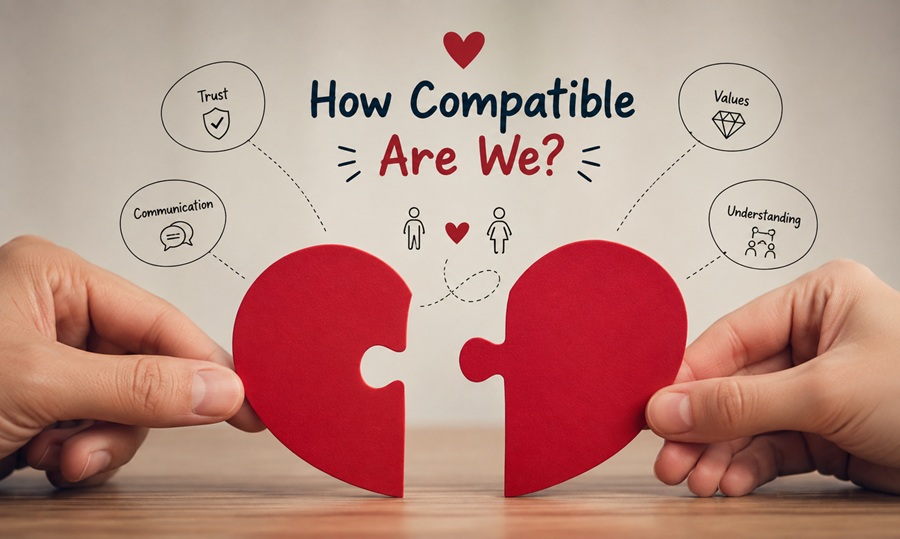
To honestly gauge compatibility, look at how you and your partner handle conflict, whether your core values align (money, family, ambition), how you communicate under stress, and whether time together consistently feels energizing rather than draining — a five-minute online quiz can’t reliably answer this, but a structured self-assessment can.
If you searched “how compatible are we,” you’ve probably already tried a quiz or two and walked away unsatisfied — either because the result felt too generic, or because it didn’t match what your gut already suspected. That’s normal. Compatibility isn’t really a single score. It’s a pattern across several categories, and it’s worth checking each one individually.

The Five Categories That Actually Predict Compatibility
1. Communication Style
Do you both: – Feel heard during disagreements, not just during easy conversations? – Handle criticism without becoming defensive or shutting down? – Check in proactively, rather than waiting for problems to force a conversation?
2. Core Values
- Money — spender vs. saver, financial goals, debt tolerance
- Family — closeness, involvement, expectations around holidays and caregiving
- Career — ambition level, work-life balance priorities
- Kids — whether, when, how many, parenting philosophy
3. Conflict Handling
Ask yourselves: after a disagreement, do you both feel like the relationship is stronger, or does resentment tend to linger? The presence of conflict isn’t a red flag — the pattern of how it resolves is what matters.
4. Lifestyle Fit
- Social needs — how much time apart vs. together feels right for each of you
- Daily rhythms — morning person vs. night owl, structured vs. spontaneous
- Interests — some overlap helps, though total overlap isn’t necessary
5. Emotional Safety
Do you feel like you can be fully yourself, including your less polished moments, without fear of judgment or punishment?
A Simple Self-Assessment
Rate each statement 1 (rarely true) to 5 (almost always true), separately, then compare:
- We resolve disagreements without long-lasting resentment.
- Our views on money are compatible enough to plan a future together.
- I feel emotionally safe being fully honest with my partner.
- We agree, broadly, on what we want our life to look like in five years.
- Time with my partner generally leaves me feeling recharged, not drained.
A cluster of low scores in the same category is more informative than a single low score — it points to where the real friction lives.
What High Compatibility Actually Looks Like
| Sign | Why It Matters |
|---|---|
| Disagreements stay respectful | Predicts long-term relationship stability |
| Shared vision of the future | Reduces resentment over major life decisions |
| Comfortable silence | Indicates genuine ease, not performance |
| Mutual effort, not one-sided | Sustainable long-term |
| Growth feels mutual, not competitive | Supports both individuals’ development |
What Low Compatibility Often Looks Like
- Constant negotiation over basic values rather than occasional compromise
- One partner regularly changing themselves to keep the peace
- A pattern of unresolved arguments about the same core issues
- Chronic anxiety or uncertainty about where you stand
FAQ
Can two very different people still be compatible?
Yes, differences in personality or interests matter far less than alignment on core values and healthy conflict resolution.
Is chemistry a sign of compatibility?
Not necessarily — chemistry indicates attraction, while compatibility is about sustainable day-to-day and long-term fit.
How often should couples check in on compatibility?
Periodically, especially during major life transitions like a move, career change, or the addition of children.
Can compatibility change over time?
Yes, both positively and negatively — people grow and change, which is why ongoing communication matters more than a one-time assessment.
Are online compatibility quizzes accurate?
They can be a fun conversation starter, but they rarely capture the nuance of real-life conflict handling and shared values.
What if we score low in one category but high in others?
Focus on that specific area with intentional conversation rather than assuming overall incompatibility — most relationships have at least one growth area.
“How compatible are we?” isn’t answered by a single quiz result — it’s answered by paying honest attention to the categories above, together, over time.