
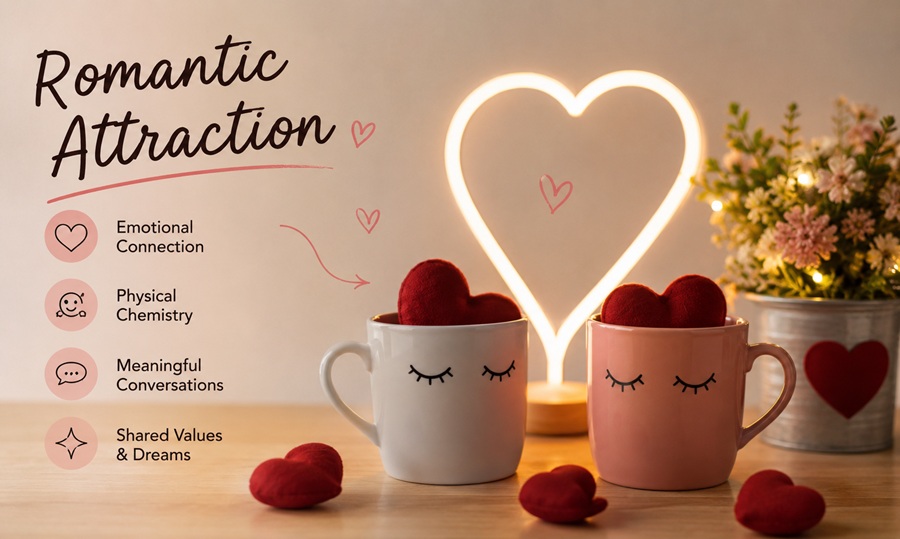
Why do we fall for some people instantly and take months to warm up to others, if at all? Romantic attraction has been studied from biological, psychological, and social angles, and the honest answer is: it’s a mix of all three, not a single mysterious spark.
Romantic attraction is a combination of biological drives (hormones like dopamine and oxytocin), psychological factors (familiarity, similarity, timing), and social context (proximity, shared experiences). It can develop instantly or build gradually, and it’s distinct from — though often connected to — sexual attraction and long-term love.


The Biology Behind It
When attraction sparks, the brain releases a cocktail of chemicals:
- Dopamine — drives the excitement and motivation of early attraction
- Norepinephrine — contributes to the racing heart, sweaty palms feeling
- Oxytocin — builds bonding and trust, increasing with physical closeness
- Serotonin — often decreases early on, which researchers believe contributes to the obsessive, can’t-stop-thinking-about-them quality of new attraction
The Psychological Factors
Mere exposure effect. Familiarity itself tends to increase attraction — which is part of why people often develop feelings for coworkers, classmates, or long-time friends.
Similarity. Despite the “opposites attract” myth, most research finds people are drawn to those who share similar values, interests, and communication styles.
Timing. Attraction is heavily influenced by whether someone is emotionally available and ready for connection at the moment you meet them — the same person might spark nothing at one point in life and everything at another.
Mystery and unpredictability. Some uncertainty can heighten attraction short-term (this is part of why “playing hard to get” sometimes works), though it tends to undermine trust and stability long-term.
Physical vs. Emotional vs. Romantic Attraction
| Type | Definition | Can Exist Without the Others? |
|---|---|---|
| Physical attraction | Draw toward someone’s appearance | Yes |
| Emotional attraction | Draw toward someone’s personality/inner world | Yes |
| Romantic attraction | Desire for a romantic relationship with someone | Often combines both, but not always |
| Sexual attraction | Desire for physical/sexual intimacy | Distinct, though frequently overlaps |
Understanding these as separate (though overlapping) categories helps explain situations like feeling romantic but not sexual attraction, or vice versa.
Why Attraction Fades — and Why It Doesn’t Have To
The intense, dopamine-driven phase of new attraction naturally settles after roughly one to two years in most relationships, replaced by an oxytocin- and vasopressin-driven bond associated with deeper attachment. This is a normal biological shift, not necessarily a sign something is wrong.
What sustains attraction long-term:
- Continued novelty — trying new experiences together
- Ongoing emotional intimacy and vulnerability
- Maintaining individual identity outside the relationship
- Physical affection and intentional quality time, even amid routine
Common Misunderstandings About Attraction
- “If the spark is gone, the relationship is over.” The early spark is chemically different from long-term bonding — its fading doesn’t necessarily indicate incompatibility.
- “Attraction should feel instant to be real.” Many long-lasting relationships build attraction gradually rather than instantly.
- “You can’t be attracted to more than one person’s qualities at once.” Fleeting attraction to others while in a committed relationship is common and, on its own, not necessarily a threat to the relationship.
FAQ
Can romantic attraction develop without physical attraction?
Yes, though it’s less common — some people experience “slow-burn” attraction that starts emotionally and develops physical elements over time.
Why do I feel more attracted to unavailable people?
Uncertainty can heighten short-term attraction chemically, but this pattern is worth examining if it consistently leads to unfulfilling relationships.
Is it normal for attraction to fluctuate in a long-term relationship?
Yes — stress, health, and routine all affect attraction levels, and most couples experience natural ebbs and flows.
Can you reignite attraction that’s faded?
Often, yes — introducing novelty, prioritizing emotional connection, and addressing underlying relationship issues can help rebuild it.
Is attraction a choice or something that just happens?
Initial attraction tends to be involuntary, but sustaining it long-term involves intentional choices and effort.