
Most couples don’t fight because they don’t love each other — they fight because they’re using two different communication languages and no one’s translating. The exercises below are drawn from approaches commonly used in couples counseling, adapted for at-home practice.
Effective communication exercises for couples include active listening drills, the “speaker-listener” technique, scheduled check-ins, and structured conflict conversations — all designed to slow down reactive communication and build genuine understanding between partners.


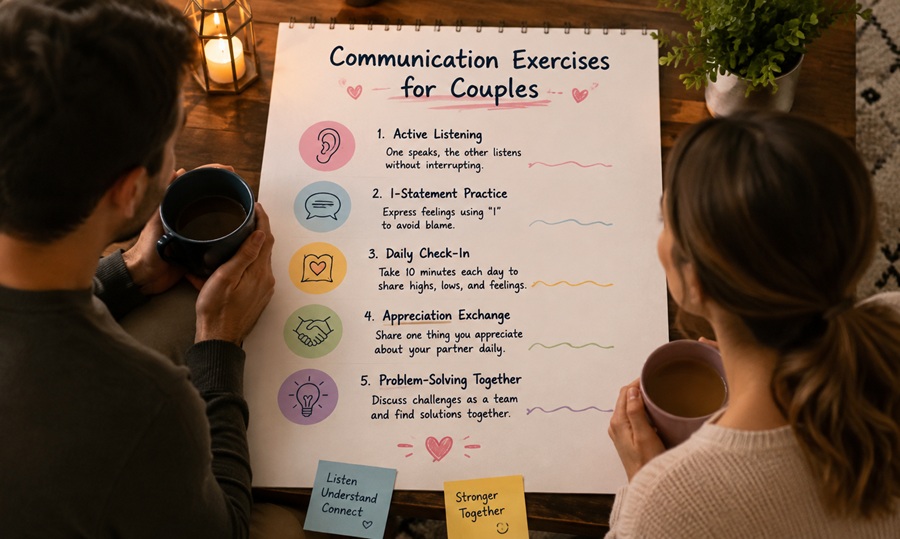
Exercise 1 — The Speaker-Listener Technique One partner speaks for two minutes uninterrupted while the other only listens. The listener then summarizes what they heard before responding. Switch roles. This slows down escalation and forces real listening instead of rebuttal-planning.
Exercise 2 — Daily Check-In Spend five minutes each evening answering: “What was the best part of your day?” and “What’s one thing on your mind?” Small and consistent, this keeps couples from drifting into parallel lives.
Exercise 3 — The Weekly State of the Union A longer, scheduled 20–30 minute conversation covering what’s working, what’s not, and any logistics needing attention. Keeping it scheduled (rather than reactive) reduces the chance it turns into an ambush.
Exercise 4 — “I Feel” Statements Practice reframing complaints from accusation (“You never listen”) to ownership (“I feel unheard when I’m interrupted”). This alone reduces defensiveness significantly.
Exercise 5 — The 20-Minute Time-Out Rule When a conversation gets too heated, either partner can call a time-out. The rule: return to the conversation within 20–30 minutes, not indefinitely postponed.
Exercise 6 — Gratitude Exchange Each partner shares one specific thing they appreciated about the other that week. Specificity matters more than frequency.
Exercise 7 — Curiosity Questions Once a week, ask a question you don’t already know the answer to — about their childhood, current stress, or hopes for the future. Long-term partners often assume they know everything; this exercise counters that assumption.
Exercise 8 — The Repair Attempt Practice Agree in advance on a phrase or gesture either partner can use mid-conflict to signal “I want to de-escalate,” without it being seen as giving up the argument.
Exercise 9 — Values Mapping Separately list your top five values (family, career, adventure, security, etc.), then compare. Discuss overlaps and differences calmly, outside of conflict.
Exercise 10 — Nonverbal Check-In Sit facing each other for two minutes of eye contact without talking. It sounds simple; most couples find it surprisingly revealing.
Exercise 11 — The Complaint vs. Criticism Sort Take a recent frustration and rewrite it as a specific complaint about behavior rather than a criticism of character. (“The dishes piled up again” vs. “You’re so lazy.”)
Exercise 12 — Future Visioning Spend 15 minutes describing, separately, what you each want your life to look like in five years, then share and compare.
When to Use Which Exercise
| Situation | Recommended Exercise |
|---|---|
| Feeling distant/disconnected | Daily Check-In, Gratitude Exchange |
| Frequent arguments | Speaker-Listener, Time-Out Rule |
| Uncertain about the future | Values Mapping, Future Visioning |
| Recurring same fight | Complaint vs. Criticism Sort |
| Want more depth | Curiosity Questions, Nonverbal Check-In |
Tips for Making These Stick
- Schedule them rather than waiting for a “good moment” that may never come
- Start with lower-stakes exercises before attempting ones tied to active conflict
- Don’t use exercises mid-argument as a way to “win” — they work best as proactive practice
- Consider working with a couples therapist if recurring conflicts don’t improve with home practice
FAQ
How often should couples do communication exercises?
Daily check-ins work best done briefly every day, while deeper exercises like Values Mapping or Future Visioning are effective monthly or as needed.
Do these exercises work for long-term relationships, or just new couples?
Both — many are specifically designed for couples who’ve been together years and have fallen into communication ruts.
What if my partner is resistant to trying these?
Start small and frame it as an experiment rather than a fix, which tends to feel less confrontational than presenting it as a problem to solve.
Can communication exercises replace couples therapy?
For mild to moderate communication issues, often yes; for deeper, recurring conflict, a licensed therapist can offer more tailored guidance.
Which exercise is best for couples who avoid conflict entirely?
The Speaker-Listener Technique and “I Feel” Statements tend to help conflict-avoidant couples practice raising issues in a structured, lower-risk way.