
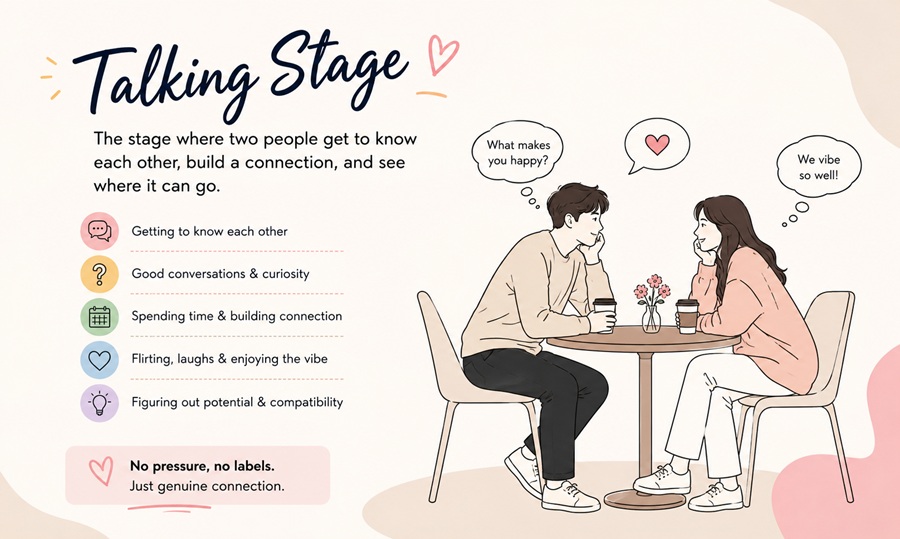
The talking stage is the period between meeting someone and officially dating, where two people text, flirt, and go on casual dates to gauge interest without commitment. It typically lasts anywhere from two weeks to three months and ends in either a relationship, a slow fade, or an explicit conversation about exclusivity.
If you’ve ever tried to explain your love life to a parent and watched their face go blank at the phrase “we’re just talking,” you already know the talking stage needs no formal introduction to anyone under 35 — and a full glossary entry for everyone else. It’s the emotional waiting room of modern dating: not quite friends, not quite a couple, definitely checking their Instagram story views a little too often.


This guide breaks down what the talking stage actually is, how long it should last, the signs it’s going somewhere, and what to do when it stalls out.
What Does “Talking Stage” Actually Mean?
The talking stage refers to the getting-to-know-you period before two people define their relationship. It usually involves:
- Regular texting or messaging, often daily
- One or more casual dates or hangouts
- Flirting, but without an explicit label like “boyfriend” or “girlfriend”
- Uncertainty about whether either person is seeing other people
It sits between “we matched on an app” and “we’re officially together.” Some couples move through it in ten days. Others linger for months, never quite finding the moment — or the nerve — to define things.
Talking Stage vs. Situationship vs. Dating: What’s the Difference?
People use these terms interchangeably, and that’s part of why the talking stage feels so confusing. Here’s the actual distinction:
| Term | Definition | Typical Duration |
|---|---|---|
| Talking stage | Early, low-commitment getting-to-know-you phase | 2 weeks–3 months |
| Dating | Actively going on dates, may or may not be exclusive | Ongoing until defined |
| Situationship | An undefined relationship that has lasted well past the talking stage without commitment | Months to years |
| Relationship | Mutually agreed exclusivity or commitment | Ongoing |
The key difference: the talking stage is supposed to be temporary. A situationship is what happens when the talking stage never ends.
Signs the Talking Stage Is Going Well
You don’t need a psychology degree to read the room, but these signals are worth paying attention to:
- Response times are consistent. Not instant, but reliable — they’re not leaving you on read for two days.
- They ask follow-up questions. Real curiosity, not just waiting for their turn to talk.
- Plans get made and kept. Someone who’s genuinely interested follows through on dates.
- They introduce you to their world. A friend’s name comes up, a tagged photo, an invite to something low-stakes.
- The conversation moves beyond surface level. You’re talking about more than just “how was your day.”
Signs It’s Time to Walk Away
Not every talking stage deserves to become a relationship. Watch for:
- Communication that’s entirely one-sided in effort
- Vague or contradictory answers about what they want
- Weeks of “talking” with zero attempt to meet in person
- Hot-and-cold behavior that leaves you constantly guessing
- A refusal to have any conversation about where things stand
How Long Should the Talking Stage Last?
There’s no universal rule, but relationship counselors generally point to six to eight weeks as a reasonable window to get a clear read on someone’s intentions. That doesn’t mean you must define the relationship by week eight — it means you should have enough information by then to know whether it’s worth continuing.
If you’re three months in and still avoiding the “what are we” conversation, that avoidance is itself an answer.
How to Move the Talking Stage Forward
- Increase in-person time before increasing text time. Texting can fake chemistry; dates can’t.
- Say what you want, plainly. “I like spending time with you and I’d like to see where this goes” costs you nothing and clarifies everything.
- Watch actions over the following week, not just the response. Anyone can say the right thing once.
- Set a personal timeline. Decide for yourself how long you’re willing to stay undefined, and honor it.
Tip: The person who brings up “the talk” first isn’t losing leverage — they’re saving time. Ambiguity almost always benefits whoever is less invested.
Frequently Asked Questions
Is the talking stage the same as dating?
Not exactly. Dating usually implies planned, repeated outings with romantic intent, while the talking stage can happen mostly over text with minimal in-person contact.
Can you be talking to more than one person at once?
Yes, and it’s common — since exclusivity hasn’t been established, most people assume it’s fair game unless stated otherwise. If that bothers you, say so early.
Why does the talking stage feel so stressful?
Because it runs on ambiguity. Human brains are wired to want clear signals, and the talking stage is designed to withhold them until someone commits.
What if they say they’re “not ready for a relationship” during the talking stage?
Take it at face value. It’s rarely a puzzle to solve — it’s usually a direct answer about their current availability.
Should I stop talking to someone else once the talking stage starts feeling serious?
Only once you’ve had an explicit conversation about exclusivity. Assuming exclusivity without discussing it is one of the most common talking-stage mistakes.
How do I know if the talking stage is turning into a situationship?
If months have passed with consistent contact but no progress toward a defined relationship, and neither of you has addressed it, that’s the tell.
The Bottom Line
The talking stage isn’t a problem to fix — it’s a filter. Used well, it tells you quickly whether someone’s effort matches their words. The mistake isn’t being in a talking stage; it’s staying in one indefinitely out of fear of asking a simple question.