
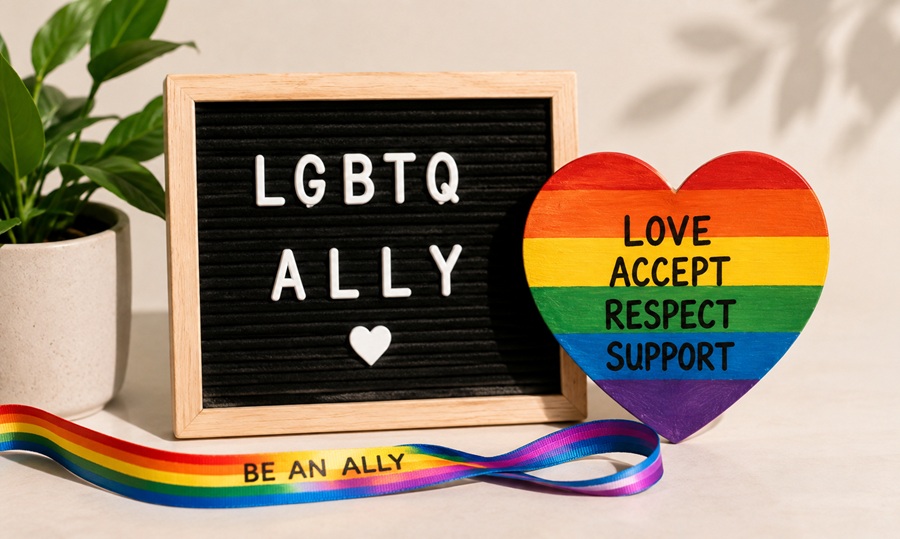
Being an LGBTQ+ ally means actively supporting the LGBTQ+ community through everyday actions — using correct names and pronouns, challenging discriminatory comments, educating yourself instead of relying on LGBTQ+ people to explain everything, and showing up consistently, not just during Pride Month.
Being an ally isn’t a label you assign yourself once and then stop thinking about — it’s closer to a practice, something you keep doing. This guide is meant as a working starting point, not a finish line.
What Allyship Actually Requires
- Consistency. Support that only shows up in June isn’t support, it’s a marketing calendar.
- Listening more than talking. Especially in spaces where LGBTQ+ people are already speaking for themselves.
- Accepting correction gracefully. Getting something wrong and being told so is part of the process, not a personal failure.
- Using your position when it’s useful. Allies often have social or professional standing that can shift a room in ways a direct target of discrimination cannot always safely do themselves.
Everyday Actions That Matter
- Ask for and use correct pronouns — and correct yourself calmly if you slip up
- Don’t assume anyone’s sexual orientation or gender identity based on appearance
- Interrupt jokes or comments that rely on LGBTQ+ people as the punchline
- Support LGBTQ+-owned businesses and creators when possible
- Advocate for inclusive policies at work — bathrooms, benefits, dress codes
- Don’t out someone without their explicit permission, ever
- Follow LGBTQ+ voices directly rather than relying only on secondhand summaries
Language Basics Worth Knowing
| Term | Quick Meaning |
|---|---|
| Sexual orientation | Who someone is romantically or sexually attracted to |
| Gender identity | A person’s internal sense of their own gender |
| Transgender | Someone whose gender identity differs from the sex assigned at birth |
| Cisgender | Someone whose gender identity matches the sex assigned at birth |
| Nonbinary | A gender identity outside the binary of exclusively male or female |
| Coming out | The ongoing process of sharing one’s identity with others |
Language evolves, and preferred terms can vary by person and community — when in doubt, ask respectfully how someone describes themselves, and use that.
Mistakes Well-Meaning Allies Often Make
- Centering their own feelings (“I feel so bad”) instead of the person affected
- Treating one LGBTQ+ friend as a spokesperson for an entire community
- Performative support with no follow-through in daily behavior
- Assuming allyship is finished once it’s been stated publicly
Note: Discomfort while learning is normal and not a sign you’re doing something wrong — it’s often a sign you’re actually engaging rather than staying comfortably uninformed.
How to Respond When You Make a Mistake
- Acknowledge it briefly
- Correct it
- Move on without turning the moment into a request for reassurance
Over-apologizing shifts the emotional labor back onto the person who was affected — brief, sincere correction is usually the more respectful path.
FAQ
Do I need to be part of the LGBTQ+ community to be a good ally?
No. Allies are, by definition, typically people outside the community who choose to support it consistently.
What should I do if a family member makes a homophobic joke at dinner?
Address it calmly in the moment if it’s safe to do so — silence is often read as agreement, even when that’s not the intent.
Is it okay to ask someone about their gender identity?
Only if the relationship and context make it appropriate, and only with genuine respect — unsolicited or invasive questions about someone’s body or history are not appropriate, even out of curiosity.
How can workplaces support LGBTQ+ employees beyond Pride Month?
Inclusive healthcare benefits, gender-neutral facilities, nondiscrimination policies, and visible representation in leadership all matter more than seasonal branding.
What if I use the wrong pronoun by accident?
Correct yourself briefly and continue the conversation — dwelling on it draws more attention to the mistake than a quick correction does.
Real allyship is boring in the best way — it looks like consistent, unglamorous, everyday decisions rather than a single grand gesture. That consistency is exactly what makes it valuable.